
Individual vs Family Floater Health Insurance
One of the most common decisions health insurance buyers face is choosing between an Individual Health Insurance Policy and a Family Floater Health Insurance Plan. While both options provide financial protection against medical expenses, hospitalization costs, and healthcare emergencies, they are structured differently and can serve different family needs.
Selecting the right health insurance plan involves more than comparing premiums. Factors such as family size, age, medical history, healthcare requirements, and long-term coverage goals can all influence which option may be more suitable.
This guide explains the key differences between individual and family floater health insurance plans, helping you understand how coverage works, who each option is designed for, and the factors worth evaluating before making a decision.
Understanding the Two Options
Individual Health Insurance
Under an individual health insurance policy, each insured person receives their own dedicated sum insured. This means the coverage amount is reserved exclusively for that individual and cannot be shared with other family members.
Family Floater Health Insurance
A family floater plan provides a single sum insured that can be utilized by any covered family member during the policy year. This structure is often considered by families looking for comprehensive health coverage under one policy.
Which Option Should You Choose?
1.The answer depends on several factors, including:
2.Number of family members to be insured
3.Age of insured individuals
4.Existing medical conditions and healthcare needs
5.Desired sum insured and coverage level
6.Budget and premium considerations
7.Long-term family healthcare planning goals
At UNC Insurance, we help individuals and families across Delhi, Delhi NCR, Gurugram, Noida, Faridabad, and Ghaziabad compare health insurance plans based on their unique requirements. Whether you’re considering a family floater policy, individual mediclaim plan, or reviewing your existing health insurance coverage, understanding the differences can help you make a more informed decision.
The right health insurance plan should balance affordability, adequate coverage, and long-term financial protection for your family’s healthcare needs.
Insurance made simple. Expert advice, tailored to your needs.
Book a free consultation or chat on WhatsApp with a UNC Insurance advisor.
Who Should Consider Individual Health Insurance?
Individual plans provide separate coverage for each insured member and may be suitable in situations where dedicated protection is preferred.
Older Parents
Separate coverage avoids sharing the insured amount with younger family members.
Large Age Differences
Useful when healthcare risks vary significantly between family members.
Higher Coverage Needs
Allows customised coverage amounts for individuals requiring greater protection.
Dedicated Protection
The entire sum insured remains available exclusively for one insured person.
UNC Advisor Insight
Individual plans are often considered when family members have different healthcare requirements or when dedicated coverage is preferred over shared coverage.
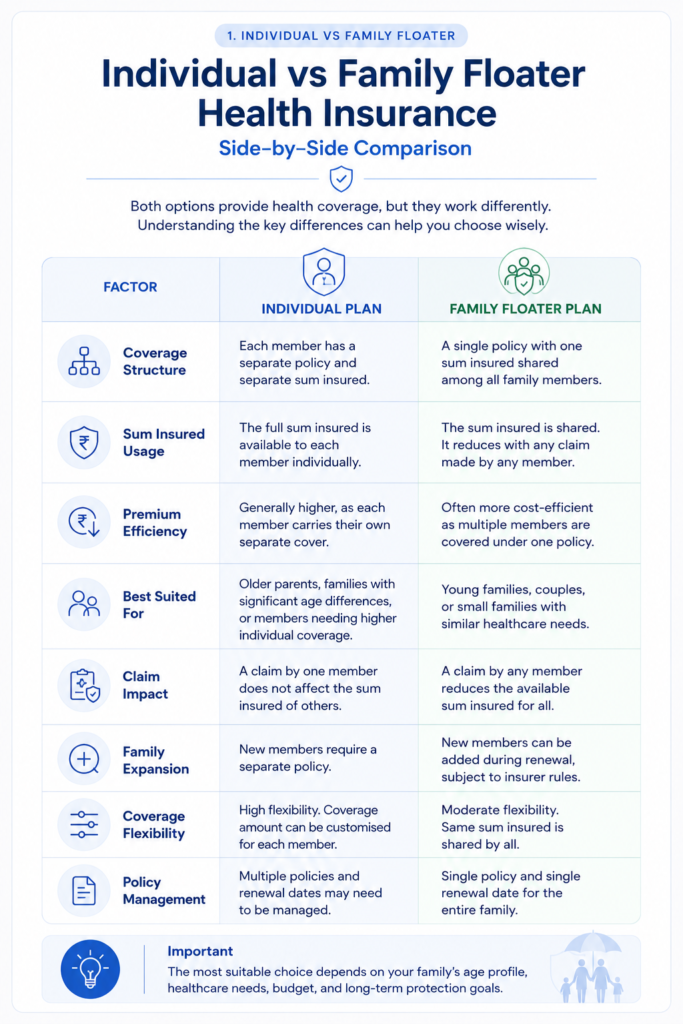
Individual Health Insurance vs Family Floater
Both options provide health coverage, but the structure of protection works differently. Understanding how coverage is allocated can help you choose the right option for your family.
UNC Advisor Insight
For many young families, a family floater may provide efficient coverage. However, when age differences are substantial or healthcare requirements vary significantly, separate individual plans are sometimes considered.
Speak With a Human Advisor
✓ Rated 5.0/5 on Google Reviews
✓ Clear Guidance Without Pressure
✓ Dedicated Claim Assistance
✓ Support Before and After Policy Purchase
✓ Personalized Recommendations Based on Your Needs
✓ 100% Free Consultation
Have questions? Book a callback or chat with an advisor on WhatsApp. We’re here whenever you need assistance.
Who Should Consider Family Floater Health Insurance?
Family floater plans provide a shared sum insured for multiple family members under a single policy and are often considered for simplicity and cost efficiency.
Young Families
One shared cover can provide protection for multiple family members under a single policy.
Couples
Often considered a cost-efficient option compared to purchasing separate individual policies.
Limited Claim History
Shared coverage may be suitable when hospitalization risk is relatively low across the family.
Simplified Management
One policy, one renewal date, and a single coverage structure for the family.
UNC Advisor Insight
Many families focus on premium savings when comparing individual and floater plans.
In practice, age differences, healthcare requirements, and claim patterns often matter more than the premium difference.
The most suitable structure is not always the cheapest one.
Frequently
Asked
Questions

Customer Reviews
I had a very smooth experience. Everything was explained clearly and patiently, which made it much easier to understand my options. I appreciated the transparency and the fact that there was never any pressure during the process.
What stood out the most was the responsiveness and professionalism. Every question was answered in a simple manner, and the entire experience felt trustworthy from start to finish.
I was looking for guidance rather than a sales pitch, and that is exactly what I received. The explanations were easy to understand and helped me make a more informed decision.
Great service and clear communication. Everything was explained in a practical way, and I always felt supported whenever I needed assistance.